Partly because of jerks like me. But it’s mostly your own illogical mind.
By Jim Saksa
Monday, Sept. 24, 2012
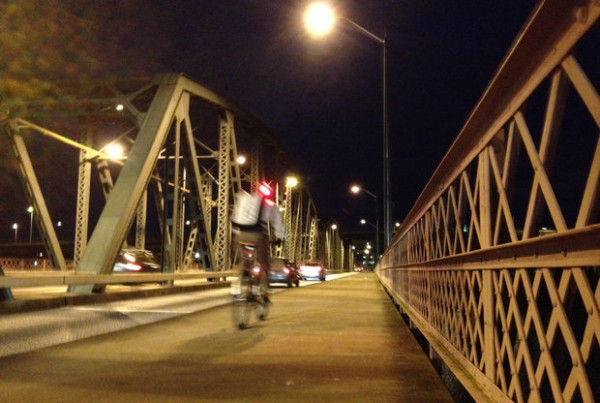
I’m an asshole cyclist. I’m that jerk weaving in and out of traffic, going the wrong way down a one-way street, and making a left on red. I’m truly a menace on the road.
But it’s not because I’m on a bike—I’m an asshole on the road no matter what. I’m also a stereotypical Jersey driver, someone who treats speed limits as speed minimums and curses those who disagree. And I’m just as bad as a pedestrian, another jaywalking smartphone zombie oblivious to the world beyond my glowing screen. If I’m moving, I’m an accident waiting to happen.
Biking is my primary means of transportation, so when someone defames cyclists, I feel particularly bad. The fact is, unlike me, most bicyclists are courteous, safe, law-abiding citizens who are quite willing and able to share the road. The Bicycle Coalition of Greater Philadelphia studied rider habits on some of Philly’s busier streets, using some rough metrics to measure the assholishness of bikers: counting the number of times they rode on sidewalks or went the wrong way on one-way streets. The citywide averages in 2010 were 13 percent for sidewalks and 1 percent for one-way streets at 12 locations where cyclists were observed, decreasing from 24 percent and 3 percent in 2006. There is no reason to believe that Philly has particularly respectful bicyclists—we’re not a city known forrespectfulness, and our disdain for traffic laws is nationally renowned. Perhaps the simplest answer is also the right one: Cyclists are getting less aggressive.
A recent study by researchers at Rutgers and Virginia Tech supports that hypothesis. Data from nine major North American cities showed that, despite the total number of bike trips tripling between 1977 and 2009, fatalities per 10 million bike trips fell by 65 percent. While a number of factors contribute to lower accident rates, including increased helmet usage and more bike lanes, less aggressive bicyclists probably helped, too.
Despite such statistics, lots of drivers assume all people on bikes are assholes like me. In doing so, these motorists are making an inductive fallacy, not unlike saying, “Of course he beat me at basketball—he’s Asian like Jeremy Lin and Yao Ming.” Now, you might be thinking to yourself that you’ve seen more than one or two suicidal cyclists in your day—that these roaches on two wheels are an infestation that’s practically begging to be squished underfoot (and by “foot” you mean “my Yukon Denali”).
First off—wow, that is disturbingly violent. Second, your estimate of the number of asshole cyclists and the degree of their assholery is skewed by what behavioral economists like Daniel Kahneman call the affect heuristic, which is a fancy way of saying that people make judgments by consulting their emotions instead of logic.
The affect heuristic explains how our minds take a difficult question (one that would require rigorous logic to answer) and substitutes it for an easier one. When our emotions get involved, we jump to pre-existing conclusions instead of exerting the mental effort to think of a bespoke answer. The affect heuristic helps explain why birthers still exist even though Obama released his birth certificate—it’s a powerful, negative emotional issue about which lots of people have already made up their minds. When it comes to cyclists, once some clown on two wheels almost kills himself with your car, you furiously decide that bicyclists are assholes, and that conclusion will be hard to shake regardless of countervailing facts, stats, or arguments.
If you are a city driver, you have undoubtedly been scared half to death by some maniac cutting across traffic like Frogger on a fixie. Such emotionally charged events stand out in our associative memory far more than mundane events, like a cyclist riding peacefully alongside your vehicle. The affect heuristic is compounded by the idea of negativity dominance—bad events stand out more than good ones. This causes you to overestimate both the amount and the severity of upsetting events, like almost getting some dirty hipster’s blood on your windshield.
Don’t believe me? Well, ask yourself, what causes more deaths: strokes or all accidents combined? Tornadoes or asthma? Most people say accidents and tornadoes, and most people are wrong. In Thinking, Fast and Slow, Kahneman asks the reader these same questions before revealing, “strokes cause almost twice as many deaths as all accidents combined, but 80 percent of respondents judged accidental death to be likely. Tornadoes were seen as more frequent killers than asthma, although the latter caused 20 times more deaths.” Kids careening on bikes are our urban tornadoes—somewhat rare, upsetting events that stick in our craw longer than they should, and seem like bigger problems than they really are.
Moreover, bicycling as a primary means of transportation—I’m not talking about occasional weekend riders here—is a foreign concept to many drivers, making them more sensitive to perceived differences between themselves and cyclists. People do this all the time, making false connections between distinguishing characteristics like geography, race, and religion and people’s qualities as human beings. Sometimes it is benign (“Mormons are really polite”), sometimes less so (“Republicans hate poor people”). But in this case, it’s a one-way street: Though most Americans don’t ride bikes, bikers are less likely to stereotype drivers because most of us also drive. The “otherness” of cyclists makes them stand out, and that helps drivers cement their negative conclusions. This is also why sentiments like “taxi drivers are awful” and “Jersey drivers are terrible” are common, but you don’t often hear someone say “all drivers suck.” People don’t like lumping themselves into whatever group they are making negative conclusions about, so we subconsciously seek out a distinguishing characteristic first.
Every time another bicyclist pulls some dickish stunt, the affect heuristic kicks in to reinforce the preconceived biases. The same isn’t true in reverse: The conviction that bicyclists are erratically moving hazards is not diminished by the repeated observance of safe and respectful riding. Facts and logical arguments that do not conform to the emotional conclusion are discounted or disregarded. But we’re not doomed to our initial prejudices: Once a person becomes aware of her biases, she is more able to engage rational thought processes to overcome the affect heuristic and dispel her inaccurate conclusions. So, study those stats bike haters!
As the studies show, more and more commuters are trading in their parking passes for bike locks. In light of those numbers, it’s heartening to hear that the number of fatalities per bike trip has decreased in Philadelphia, New York, and elsewhere. That suggests to me that these new-to-biking commuters are riding less aggressively than the old urban vanguard of bike messengers and Tour de France wannabes. If the present trends continue, we’ll see asshole bicyclists like me become an even smaller minority of bicyclists as a whole. And some of us are trying to get better. I’ve recognized that my bad behavior keeps others from taking up riding, and keeps politicians from investing in things I care about, like more bike lanes. So I’ve stopped riding on sidewalks and try to keep my illegal lefts to a minimum. But I’ve been a jerk for a real long time. So, let me say this to drivers, pedestrians, and my fellow riders alike: I’m sorry. See, aren’t cyclists the nicest, most polite people in the whole world?