Each year, somewhere between 800,000 and two million bicycles — originally believed to be worth some $50 million, but now estimated to be a billion-dollar problem — are stolen.
Because most bike theft is never reported to law enforcement, it is difficult to determine the precise number of stolen bikes. While 48% of stolen bikes are eventually recovered by police, only 5% are successfully returned to their owners.
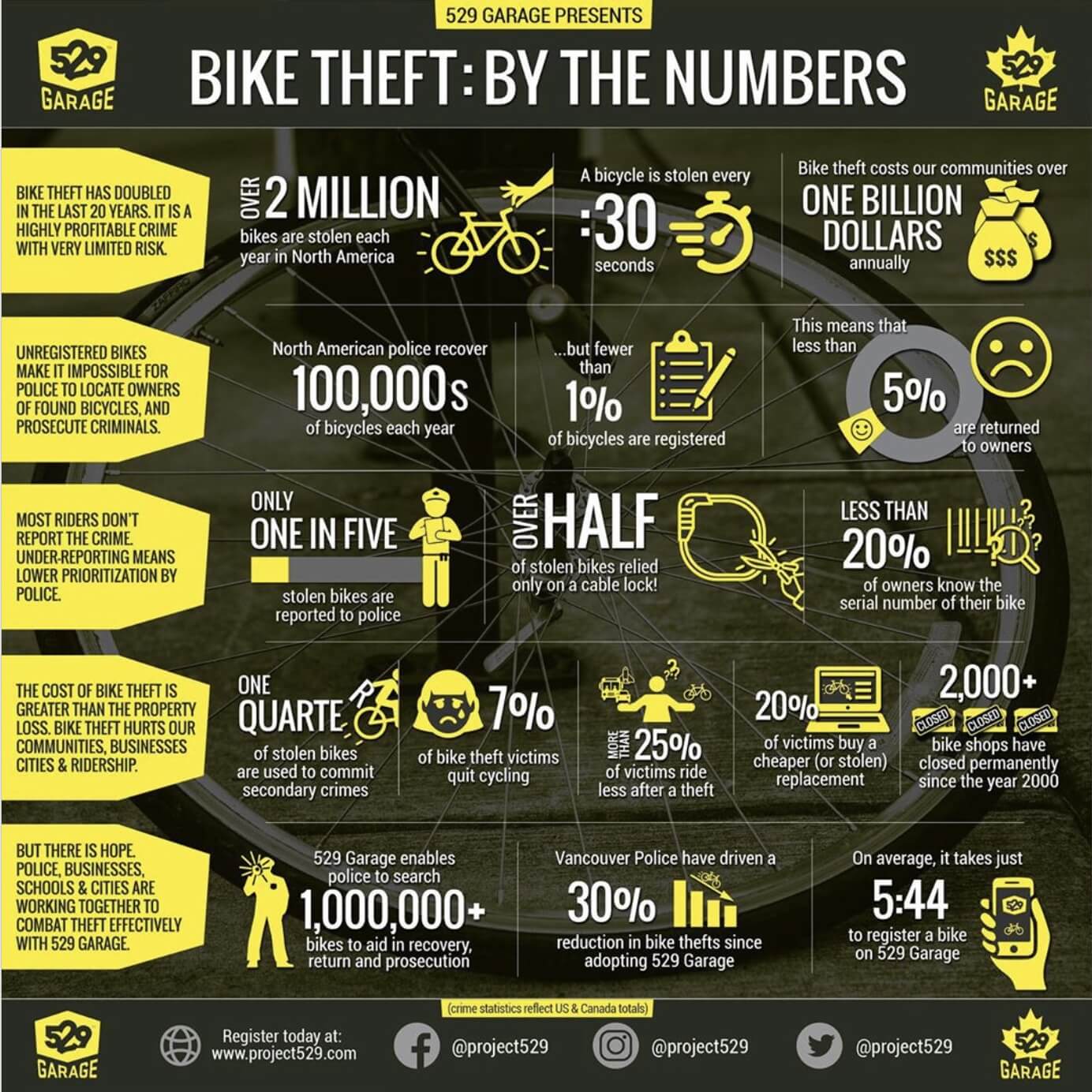
Despite these dismal statistics, you can protect your bike, and you can increase your chances of recovering your bike if it is stolen.
Where do bikes get stolen the most?
Bike thieves target locations where they can work quickly without being observed or where high-value bicycles are left for predictable periods.
- Residential Properties: Surprisingly, over 50% of bike thefts occur at the owner’s home. Unlocked garages, sheds, and shared apartment hallways are primary targets, as thieves often assume security is weaker in these “private” spaces.
- Transit Hubs: Train stations and bus stops are high-risk areas because commuters often leave bicycles unattended for the entire workday.
- Public Racks: Thieves prefer secluded racks or those tucked behind buildings where they have time to use tools without public interference.
- Commercial Centers: Shopping malls and university campuses offer a high volume of targets, allowing thieves to blend into the crowd while scouting for poorly secured bicycles.
Related Article: Pop Quiz: Bike Theft
Related Article: Ciao, Milano
How to protect your bike from theft
There are two distinct aspects to protecting your bike: Documentation, and proper locking technique, and both are essential to proper bicycle security.
Document your bicycle
It is absolutely essential that you document your bike. Far too many bike owners fail to record the serial numbers on their bikes or document any other proof of ownership. In the event of a bike theft, you want to be the bicycle owner with the necessary documentation to assist law enforcement. Begin by establishing a file for each bike you own. Record your serial number and place it in the file.
If your bike is stolen, you should also have a purchase receipt prepared as supporting documentation. Even if you are buying a used bike, ask for a receipt. If you don’t have a receipt for a bike you already own, repair receipts may serve as evidence of ownership. Keep all receipts for the bike in the file. Take photographs of the bike, including any distinguishing characteristics, and store those in the file as well. If you change the appearance of the bike, document it with additional photographs. Make a digital copy of your file on your hard drive, and keep the bike’s paper file with your other important documents.
Once you have created a file for your bike, you will want to register your bike, preferably with a nationwide or international registration service. Examples of bicycle registration services include Bike Index, a non-profit bicycle registry; 529 Garage, a bicycle registry with advanced capabilities, National Bike Registry, now merged with 529 Garage, which brings the advanced capabilities of 529 Garage to the largest bicycle registry in North America; and Bike Registry, an international registration service. Note: Bicycle Law makes no representation or recommendation about any of these registration services.
If you have homeowner’s or renter’s insurance, you should also make sure that your bike is included on your policy; be sure to specify that the bike is covered for its full replacement value.
Lock your bike properly
Documenting your bike will help you recover your bike if it’s stolen. In order to keep your bike from being stolen in the first place, you will need to practice proper locking technique whenever your bike is not in your immediate possession—every single time. Most stolen bikes are targeted for one simple reason—they were left unlocked and unattended, even if “only for a moment.” Therefore, you must lock your bike whenever it is not in your immediate possession, and preferably, whenever you are not in direct physical contact with your bike. It’s not unheard of for thieves to attempt to steal an unlocked bike while the owner is sitting only a few feet away. And even if your bike is at home, in your garage or your yard, thieves have been known to jump fences or sneak into garages to steal an unlocked bike. The lesson is, unless the bike is in your direct physical possession, never assume that it’s safe to leave your bike unlocked.
The other two factors that figure prominently in stolen bike reports are improper lock selection, and improper locking technique. To keep your bike from being stolen, it’s absolutely essential for you to understand how to select a lock, and how to use it properly. For information about proper lock selection and proper locking technique, see the How To Lock Your Bike page here on bicyclelaw.com.
Still, if you slip up, and your bike is stolen, you can take heart in knowing that nearly half of all stolen bikes are recovered by law enforcement. However, you will need to take some steps if you hope to recover your bike.
If you use a proper lock, and follow proper locking techniques, it is unlikely you will ever lose your bike to a thief. There are simply too many other unlocked or poorly locked bikes out there for a thief to waste time trying to steal your well-locked bike. Still, if you slip up, and your bike is stolen, you can take heart in knowing that nearly half of all stolen bikes are recovered by law enforcement. However, you will need to take some steps if you hope to recover your bike.
What to do if your bike is stolen
First, notify law enforcement by filing a stolen bike report. This is where your file documenting ownership of your bike will first be utilized—you will want to provide law enforcement with the bike’s serial number and a photo of the bike. You need to file the stolen bike report because if police recover your stolen bike, or if you find it yourself, the stolen bike report serves as evidence that your bike was stolen. Without this evidence on file, you will be unable to reclaim your stolen bike from the police.
Next, you should conduct your own search for the bike. Look on online sites, such as Craigslist and eBay. Be aware that thieves will sometimes steal a bike in one city and advertise it for sale in another city. Some thieves will attempt to evade detection by the owner by providing a vague description of the bike in the ad.
Bring a photo of the bike and make the rounds of the pawn shops and second-hand stores in your area. If a thief tries to sell your stolen bike to them, they may recognize the bike. If they have already bought the bike, the documentation you have filed, along with the stolen bike report, will be proof that the bike is yours, and you will be entitled to recover the bike through procedures established by state law—check with your local law enforcement agency for those procedures. Despite what anyone may tell you, you are not required to pay a pawn shop for return of your stolen bike.
You should also make the rounds of the bike shops in your area. Thieves will sometimes attempt to sell stolen bikes to bike shops, especially if the shop sells used bikes. If you notify the shops, and can provide a photo, the shops may notify law enforcement if they see a bike matching your stolen bike.
Finally, check the police impound yard from time to time—your bike will end up there if it is recovered. Law enforcement should notify you, but just in case they’re not as diligent as you, it won’t hurt to look. Also, check the impound yard of your local transit agency—you’d be surprised how many bikes are left behind on buses. If somebody—the bike thief, or an unsuspecting buyer—accidentally leaves your stolen bike on the bus, the transit agency impound yard is where you will want to look.
If you do find your bike, notify law enforcement for assistance in recovering your bike. It is legal to recover your stolen bike yourself, but it is not risk-free, so if there is time to wait for law enforcement, seek law enforcement assistance to recover your bike.
- Related Article: Catch a Thief
- Related Article: Taking the Law Into Your Own Hands
- Related Article: My Stolen Bicycle
If law enforcement recovers your bike, they should notify you, based upon the stolen bike report you filed. You will need your stolen bike report and proof that the bike belongs to you before law enforcement will release it to you—thus, the importance of documenting your ownership of the bike and keeping it in a file.
FAQs About Bike Theft Prevention
Is there a bike lock that is impossible to cut?
No lock is completely indestructible, but high-quality options are designed to be extremely difficult and time-consuming to break. These locks act as a deterrent because they require specialized tools and a long time to bypass.
Which types of bicycles are most frequently targeted by thieves?
Thieves usually target expensive models like e-bikes and high-end mountain bikes because they are easier to sell for a high price. However, even older bikes are at risk if they are left unlocked or poorly secured.
Does the color of a bike affect its risk of being stolen?
Bikes with bright or unusual colors are often less attractive to thieves because they stand out and are easier for people to recognize. A unique-looking bike is harder for a thief to hide or sell quickly.
For more information
For information about insuring your bike against loss from theft, and filing a claim if your bike is stolen, see Insurance Advice.
For information about protecting your bicycle through proper locking technique, see How To Lock Your Bike.
FAQs About Bike Theft Prevention
Is there a bike lock that is impossible to cut?
No lock is completely indestructible, but high-quality options are designed to be extremely difficult and time-consuming to break. These locks act as a deterrent because they require specialized tools and a long time to bypass.
Which types of bicycles are most frequently targeted by thieves?
Thieves usually target expensive models like e-bikes and high-end mountain bikes because they are easier to sell for a high price. However, even older bikes are at risk if they are left unlocked or poorly secured.
Does the color of a bike affect its risk of being stolen?
Bikes with bright or unusual colors are often less attractive to thieves because they stand out and are easier for people to recognize. A unique-looking bike is harder for a thief to hide or sell quickly.