
“I didn’t see him.”
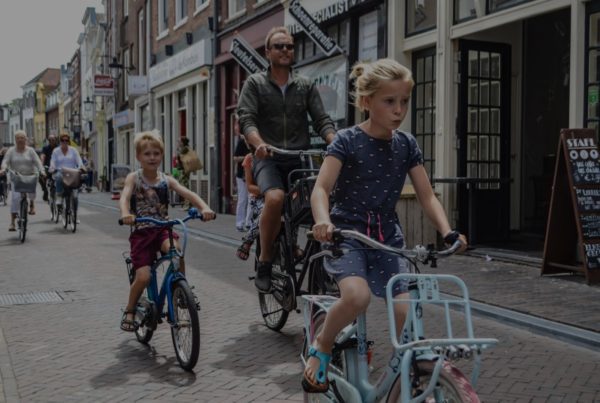
It’s the most common excuse negligent drivers make after colliding with a cyclist. And it makes no difference whether the cyclist is wearing bright colors or “lit up like a Christmas tree“—negligent drivers will still utter these four words after hitting the cyclist. Except, of course, in the Netherlands, where the presumption of liability encourages drivers to be more careful about seeing cyclists.
In a recent case in the United Kingdom, a driver accused in the death of a cyclist offered “I didn’t see him” as her defense. “He came out of nowhere,”19 year-old Katie Hart explained.
On May 3 of 2009, Hart was driving on the A1 carriageway. A 25 mile time trial was underway that day; British Army Major Gareth Rhys-Evans was riding in the time trial, when Hart hit him from behind. Upon impact, Rhys-Evans was thrown up over and behind Hart’s car. Despite the best efforts of his fellow competitors and paramedics, Rhys-Evans died at the scene of he crash. 38 years old, Rhys-Evans left behind a wife and two young children.
Another cyclist, Clare Lee, who had been passed by Hart moments before, described what happened:
“[Hart’s car] passed so close to me that it took my breath away, about a foot away.”
Lee said that her “heart sank” shortly afterward, when she arrived at the crash scene and realized that the same car that had brushed so closely by her had just hit a cyclist.
At trial, Hart had no recollection of passing Lee, and told the Crown Court that she did not see Rhys-Evans until after the impact, when she looked in her rear-view mirror and saw that she had hit a cyclist.
In the immediate aftermath, Hart was described by witnesses as “hysterical.”
“It was just one of those things,” she explained to police at the scene.
It was just one of those things.
On January 27, 2010, Hart was found guilty of causing death by dangerous driving, and will be sentenced on February 15.


I’m always amazed that drivers are allowed to get away with that lamest of all excuses; I’m only glad Ms. Hart didn’t get away with it this time.
My understanding of traffic law is that drivers are required to be alert and aware of road conditions and the traffic around them at all times; unless the driver’s view is actually obstructed in some way, I don’t see how it is possible to fulfill that obligation and yet still fail to see someone on the road right in front of you.
I’ve argued several times on my blog for the need to pass a comprehensive bike safety law in California (see “Change the law. Change the World.” at the top of the page). And one of the most important of these reforms is to permanently ban “I just didn’t see him” as a mitigating factor in any collision.
As far as I’m concerned, if a driver says he or she didn’t see a cyclist or pedestrian or any other road user, for that matter it should be considered a confession, not an excuse.
I agree. If a “reasonable person” would find that a cyclist would be visible to a driver who is keeping a proper lookout and exercising the due care of a “reasonable person,” then when a driver says “I didn’t see him,” it should be taken as an admission that the driver wasn’t keeping a proper lookout, or exercising the due care required of vehicle operators.
I agree with bikinginla, “I didn’t see him” should be a confession to negligence. We’re not going to solve our safety problems until we stop treating irresponsible and incompetent driving as a fact of life. Just one of those things…
It’s the same mindset that drives uninformed law enforcement to try and remove lawful cyclists from road. They’ve mixed up cause and effect. It’s not the presence of the cyclist that’s the safety problem, it’s the behavior of the motorists.
Not long ago I represented the family of a man who was killed while riding his bicycle through an intersection here in Illinois. The light was in his favor and a witness testified that the man had carefully stopped and looked in all directions before proceeding. The defendant driver struck him as she attempted to make a left turn. She testified that she never saw him. She put forward two rather incredible reasons, I thought, for having not seen him: (1) It was December and she didn’t think any one would be out riding a bicycle during that time of year; and (2) Her minivan’s windshield beam obstructed her view to the the left. We aggressively pursued the case until the defendant gave in and settled.
That these excuses were put forward as “defenses” at all was down right silly. I agree with bikinginla that “I didn’t see him” should be a confession, not a defense.
As a bike commuter, even during the winter here in Alaska, I’m happy to see some states are starting to propose “vulnerable user” laws that have increased penalties for drivers who are involved in car wrecks that cause major injury or death to cyclists or pedestrians. Oregon recently passed a vulnerable user bill, and Washington is supposed to debate one in the Legislature during February 2010.
While I realize there are scofflaw cyclists who think traffic laws don’t apply to them, I know of too many cases where witnesses said the cyclist or pedestrian was doing everything correctly only to have an inattentive driver plow him or her over. I have 3-4 working headlights on my bike at all times, a flashing taillight and two more red reflectors on the back, reflective ankle straps, reflective tape on the jacket, backpack and helmet, etc., but I’ve still had cases where I could move my hand a couple of inches to feel cars or trucks as they pass by. We also have more people doing the distracted driving thing, with cellphones, smokes, food, squirrely kids in the back seat, and once I even saw a driver reading a book on his commute. Driving is a full-time job. Hang up the cellphone, put both hands on the steering wheel and drive.
Last year I lost a friend to a horrible bicycling accident when he was killed.
Had he signaled properly this accident may never have occurred.
Why turning signals are not a requirement for all bikes, I’ll never understand.
I purchased mine at safetybikesignals.com.
Thanks for your comment Richard. You might be interested to know that Bob mentioned safetybikesignals.com in his Road Rights article on signaling requirements:
http://bicycling.com/blogs/roadrights/2009/10/05/turning-points/
Why, Richard? Because people have arms. Keep up the junior lobbying though!
I wonder how the whole issue of population density plays into cycling safety in general. I know that the population density in the most of the UK tends to be much greater than in the Midwestern US where I live; I wonder if the higher population density in the UK (and, for that matter, in built-up areas of the US such as the east coast) makes bicycle commuting somewhat more dangerous, since theoretically a cyclist will deal with more vehicles per mile of travel than in less population dense areas. This danger might be offset, though, by generally shorter commutes for those living in population-dense areas.
@richard, I’m not sure that bicycle turn signals would help much, though I could be wrong. For one, I think the novelty of it would confuse people, at least until such equipment becomes universal on bikes; John Q. Driver is more likely to initially think, “What the heck is that flashy thing on that bicycle?” than he is to think, “Gee, that bicycle is going to turn left.” I think that the best solution is to use a rear view mirror, to signal a turn with the ipsilateral arm long enough for all nearby vehicles to see, and to scrutinize all adjacent vehicles before going through with a turn…if there’s a vehicle that is moving at a pretty good clip and looks like he might cross your path as you turn (whether he has the right of way or not), it’s usually better just to wait. Signalling a turn is done more as a courtesy to others on the road, and should not guarantee that a turn or lane change can be done safely (anyone who has ever driven/ridden in Chicago can testify to this).