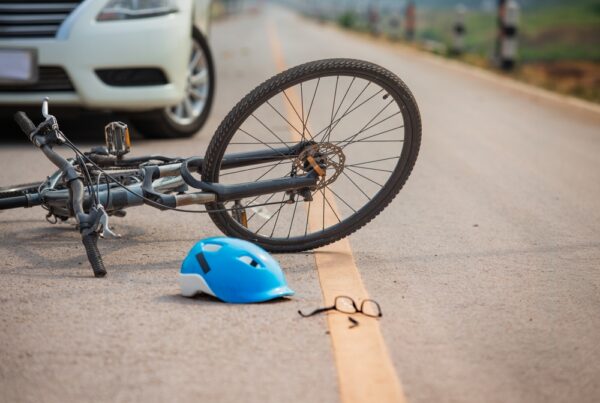
In Bicycling & the Law, one of the issues Bob addressed under the rubric of anti-cyclist bias was police bias against cyclists. Anti-cyclist bias within law enforcement manifests in several ways. One manifestation of this bias is the one-sided investigation. This occurs when the officer investigating a crash between a cyclist and a motorist interviews the motorist, but not the cyclist (who may be too injured—or dead, even—to be interviewed), and based on that one-sided investigation, concludes that the motorist was not at fault—or worse, that the cyclist was at fault. In some cases, the first contact the cyclist has with law enforcement is in the hospital, when the officer presents the cyclist with a ticket.
In Portland, Oregon, the officer investigating a crash between a motorist and bicycle commuter Kyle Egertson concluded that the cyclist was at fault, because he couldn’t respond to questions (he was suffering from a concussion following the collision), even though the motorist was also unable to respond to questions (he had gone into diabetic shock just before the collision). These one-sided investigations are harmful to the individual cyclist whose right to a fair investigation is denied. They are harmful to the rest of us, as well. Because shoddy police work leads to shoddy data and false conclusions, these one-sided investigations perpetuate the anti-cyclist bias, putting us all at further risk of being subjected to biased investigations in the future.
Another manifestation of the anti-cyclist bias is when law enforcement refuses to enforce existing laws. Thus, in Chattanooga, police refused to enforce Tennessee’s 3 foot passing law when a motorist intentionally brushed a cyclist off the road, going so far as to arbitrarily dismiss an eyewitness corroboration of the violation because of a minor discrepancy in the two cyclists’ estimates of how far apart they were when the incident occurred.
The flip side of law enforcement refusing to enforce existing laws is when police enforce non-existent laws. Thus, in Chesapeake, Ohio, a Lawrence County Deputy, believing it to be illegal for cyclists to ride on the road unless they’re riding at the speed limit, despite both case law andstatutory law to the contrary, ordered a cyclist off the road, and thentased and arrested him when he continued to ride on the road. The cyclist in that incident filed a federal lawsuit against the officer and village on August 19, a year to the day after he was tased and arrested. When cyclist David Meek was killed by a driver who sideswiped him, Chattanooga police refused to ticket the driver for violating Tennessee’s 3 foot passing law, claiming that the cyclist, who was “lit up like a Christmas tree” should have been wearing a safety vest—a “requirement” that does not exist in the law. And when cyclist Brett Jarolimek was right hooked by a garbage truck, Portland police refused to cite the driver, on the basis that “the driver has to perceive that he violated the right of way”—another invented “requirement” that does not exist in the law.
One could perhaps write these off as past, isolated incidents, except for the fact that they’re not isolated—they have occurred across the country—and they continue to occur, most recently in Los Angeles. As reported by Stephen Box on SoapBoxLA, on June 1, 2009, a woman who was riding her bike on the sidewalk approached an intersection, and began riding through the intersection in an unmarked crosswalk. As she was riding in the crosswalk,
a large truck approached the intersection on Valerio and proceeded to turn right onto Louise. The cyclist and the truck collided, she fell to the ground and the truck crushed her head as she lay on the street.
The next day, Los Angeles Councilman Greig Smith, citing his own “law enforcement experience,” as well as that of his Chief of Staff Mitch Englander, and that of Public Safety Deputy Jim Dellinger, explained in an email that
“the bicyclist was reportedly riding on the wrong side of the roadway and traveling against the traffic flow; making her the initial “primary cause” of this tragedy.”
The LAPD’s Public Information Officer confirmed the report that the LAPD considered the cyclist the “primary cause” of the incident because she was riding a bike in a crosswalk which is a violation of CVC 21200 which requires a cyclist to obey the rules of the road. The PIO explained that a cyclist must either dismount at crosswalks or ride on the right side of the road with traffic.
It’s long been a tenet of League of American Bicyclists cycling educationthat it’s safer for cyclists to ride on the road, in the same direction as traffic, than it is to ride on the sidewalk. That safety advice notwithstanding, the combined “law enforcement experience” of Councilman Smith, his staff, and the LAPD could not overcome the very basic fact that they were inventing laws that don’t exist. It is not against California law to ride a bike on the sidewalk (although it may sometimes be against local ordinance), nor is sidewalk traffic “directional”—one can walk, or ride, with or against traffic while on the sidewalk. In fact, although Section 21200 of the California Vehicle Code states that
Every person riding a bicycle upon a highway has all the rights and is subject to all the provisions applicable to the driver of a vehicle,
Section 21201(d) makes it clear that it is not in fact against state law to ride on the sidewalk.
And that brings us to crosswalks. By definition, under Section 275 of the California Vehicle Code a crosswalk is an extension of the sidewalk across the intersection. Thus, generally speaking, the legality of riding within the crosswalk will be determined by whether or not it is legal to ride on the sidewalk. If it is legal to ride on the sidewalk, it is also legal to ride within the crosswalk; if it is illegal to ride on the sidewalk, it is also illegal to ride in the crosswalk. This is the general rule; state laws may specifically address riding in the crosswalk, but where no such state law exists, the legality of riding in the crosswalk will be determined by the legality of riding on the sidewalk.
So is it illegal to ride in the crosswalk in Los Angeles? Section 80.29 of the Los Angeles Municipal Code states that
The driver of a vehicle shall not drive within any sidewalk area or any parkway except at a permanent or temporary driveway.
This is analogous to Section 21663 of the California Vehicle Code, and as we know, California law does not prohibit cyclists from riding on the sidewalk. Furthermore, and more specific to the Municipal Code, the prohibition applies to drivers of vehicles, and under state law, bicycles are not “vehicles.” Additionally, Section 56.15 of the Los Angeles Municipal Code makes it clear that it is legal for cyclists to ride on the sidewalk; the sole restriction on cyclists who ride on the sidewalk is that they may not ride “in a willful or wanton disregard for the safety of persons or property.” Because it is legal under both state and city law for cyclists to ride on the sidewalk, it is also legal for cyclists to ride in the crosswalk.
And thus, when the Los Angeles Police Department identified the cyclist as the “primary cause” of the collision that led to her death, citing “laws” that don’t actually exist, the cyclist was denied her right to a fair and impartial investigation of the crash that took her life.
Fast forward four months. Damien Newton reports in L.A. Streetsblog that the Los Angeles Police Department is “training USC Security that ‘biking in crosswalks’ is illegal.” According to USC student newspaper The Daily Trojan, the LAPD and the University of Southern California Department of Public Safety will “ramp up bike safety” with a program of enforcement directed at three specific violations: biking against the flow of traffic, not stopping at stop signs, and “riding their bikes through intersections,” all of which, the paper dutifully reports, “violate regulations.”
Except there’s one little problem with that enforcement program: Riding a bike through an intersection doesn’t “violate regulations.” And in fact, if the cyclist is on the sidewalk, biking against the flow of traffic is also legal. Addressing the reason for the enforcement action, which will involve LAPD officers “dedicated entirely to monitoring bike safety at USC,” Officer Boyce of the LAPD noted that
We will have a task force because the bicycle issue is becoming a very serious issue.
Echoing Officer Boyce’s concern, the Daily Trojan reports that
DPS Capt. David Carlisle said DPS has seen many of the same types of traffic violations as LAPD.
It is, of course, is entirely believable that DPS officers have seen students riding through crosswalks, given that it’s perfectly legal for them to do so. They’ve probably also seen students walking on the sidewalk, for that matter. It’s also entirely believable that, some four months after botching the investigation of the cyclist’s death in the crosswalk, the LAPD is still inventing non-existent laws, and erroneously advising others about enforcing these non-existent laws.
And thus, it’s entirely understandable that the university’s DPS officers are as utterly confused about the law as their partners at the LAPD. As the Daily Trojan reported,
“If bicyclists want to ride through the intersection, they should do so as a car would,” [DPS Captain] Carlisle said. “If they’re going to be in crosswalks and they have a bike they’re supposed to walk it, but they usually don’t.”
At crosswalks, [LAPD officer] Boyce said, bikes are considered vehicles, and by riding through intersections they are interfering with pedestrians.
In fact, it’s as legal for a cyclist to ride through an intersection in the crosswalk as it is for the cyclist to ride through the intersection in a traffic lane. When the cyclist is in the traffic lane, the law treats the cyclist as a vehicle operator; when the cyclist is in the crosswalk, the law treats the cyclist as a pedestrian (albeit, a pedestrian who must respect the right of way of pedestrians who are on foot—and because the cyclist is a pedestrian under the law while riding on the sidewalk, the cyclist has the duty to exercise the same caution as a pedestrian when entering the crosswalk; thus, incautiously entering the crosswalk at speed would be as illegal for the cyclist as it would be for the pedestrian). Despite the law, as the Daily Trojan reported, students who ride in the crosswalk will be ticketed, with a maximum fine of $250. The point, Captain Carlisle noted, “is not to punish, it’s to change behavior.”
The question raised by this exercise in absurdity is just whose behavior needs to be changed—cyclists who are riding within what the law allows, or law enforcement officers who are botching investigations and enforcing non-existent laws?