Except Bicycles
By Miles Cooper
While on a recent trip to Portland I was riding along a street that turned into a dead end. Under that Dead End sign? Another marvelous sign: Except Bicycles. When one rides in well-designed urban areas one starts to notice these Except Bicycles signs. They let cyclists know that traffic engineers have taken their unique needs into account and altered the built environment for riders.
Now I recognize that I am, for the most part, preaching to the choir here. If you’ve gotten this far there’s a strong chance you’re Bikes First adjacent, even if you’re not personally spiking car tires (a little Edward Abbey dark humor here — go with me on this). The sign inspired me. How do we motivate change in a car-entrenched world? Two words: tax incentives. Blisteringly exciting? Read on.

Before we get to taxes, why consider change in the first place? Think about a recent car-based errand. It may have gone something like this: You backed the car out. While doing so you nearly got hit by someone driving too fast on your street. You swore. You turned onto an arterial. Multi-laned, yet not moving despite it being early on a weekend. Road construction, a crash, who knows. But you budgeted 10 minutes for this errand and it will take far longer. More swearing. Eventually you reached the shopping center and started looking for parking. So was everyone else. Someone cut you off. More swearing. Finally, a parking space. A walk across blacktop acreage (because that parking space was really far away) into the store. Out of the store. Rinse and repeat for the drive home. Thirty minutes gone, sitting instead of moving, with elevated stress, blood pressure, and cortisol, and accompanying carbon emissions to boot.
Contrast that with biking. Bikes get us outdoors. Time outdoors tends to be restorative. That restorative time combats the global happiness crisis. Same with the light exercise induced by pedaling: more happiness. Traveling at bike speed usually results in interactions with others — neighbors, cyclists, pedestrians. Stopping to say hello is much easier and more common. These interactions with friends and strangers build community and also increase happiness. Making an additional unexpected stop to run into an additional store is simple; parking isn’t an issue. The locally spent dollars help merchants and further promote the community. That light pedaling also improves one’s health, combating our sedentary lifestyle-induced health issues and reducing the impact on our health care system. And the carbon emission? Minimal, even if one has a bean-heavy diet or rides an e-bike. The reduced car traffic means that those few who truly must drive now aren’t stuck in traffic since there are fewer cars.
Now some doubters might chime in to say this may all be true until, “Smush,” there goes the cyclist under a big rig. Ignoring for a moment the environmental design failures leading to such a smush, the premise itself is wrong. Studies looking at car commuters versus bicycle commuters concluded that bicycle commuters were 41% less likely to die than those who drove and that the associated health benefits exceeded the risks to bike commuters1.
None of the above bicycle benefits are news. We know them like we know reading is better for us than scrolling social media. Yet most folks use cars because it’s what they’ve always known and it is easier in the moment. Meanwhile, the present traffic engineering approach appears to be Orwellian and Animal Farm-inspired. To paraphrase, “All vehicles are equal, and some vehicles are more equal than others.” One only needs to consider the Except Bicycles signs. Traffic engineers aren’t supposed to favor one mode over another. Yet there it is: Except Bicycles. Those who ride know the life hack riding creates: predictable arrival times, usually with a smile on one’s face. But these few acknowledgements aren’t sufficient to get people out of cars.
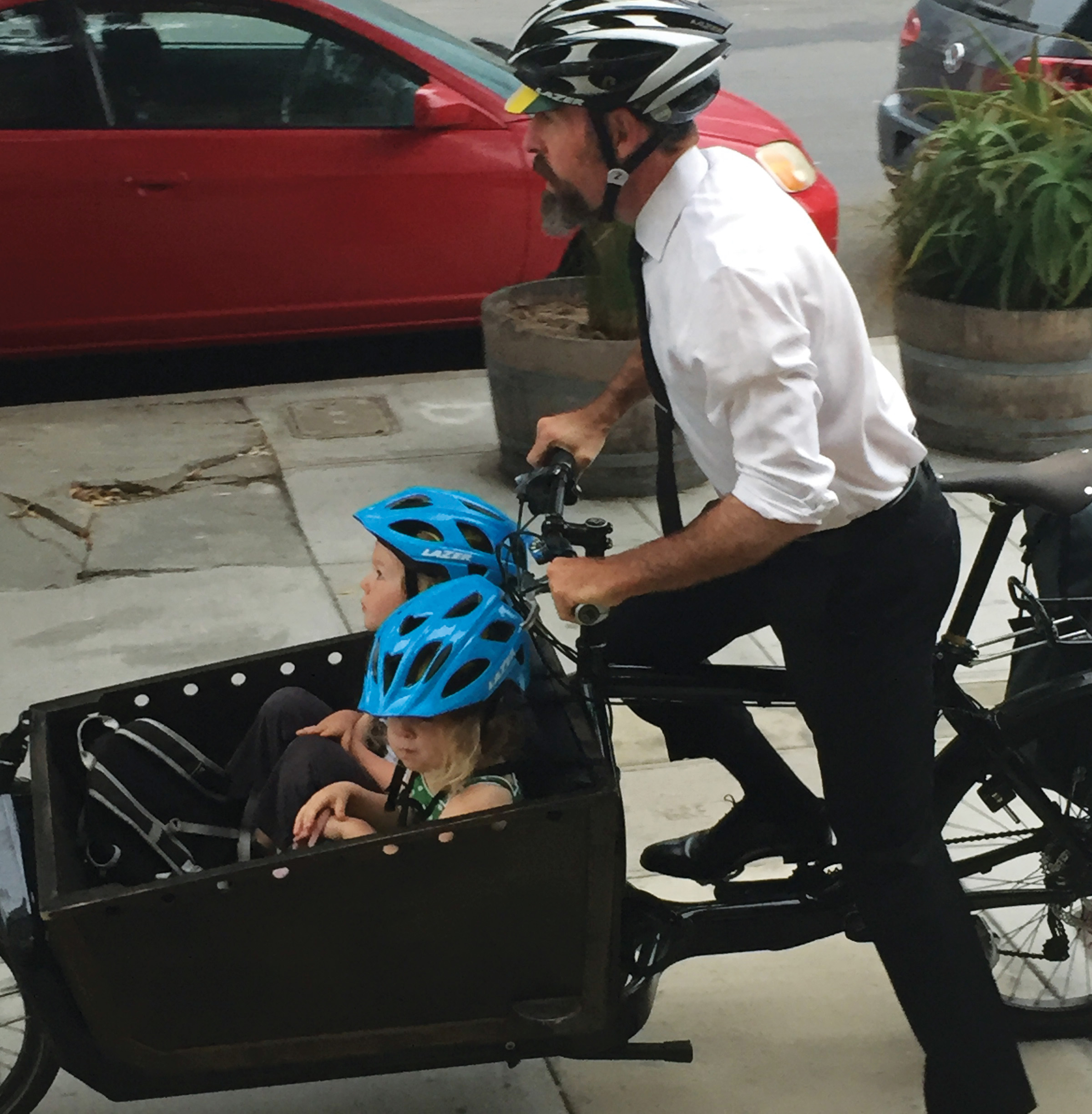 Miles driving the family minivan.
Back to tax incentives. When the government wants to change how money moves through the system, tax incentives become a primary tool. Need more electric vehicles on the road? Tax incentives. Want people to prepare for retirement or their kids’ college costs? Tax incentives. And there’s a road equivalent. If we want people to change we need to make it worth their while, and not just with an occasional Except Bicycles sign. We need bolder action for folks to move from Except Bicycles to Accept Bicycles.
Want folks to give up that rolling Lay-Z-Boy with mega-iPad sized screen? It will take a big step: with apologies to Orwell, we have to own it and go full bikes first. Two wheels good, four wheels bad. And here we’ll reference the A-word: Amsterdam. The Netherlands suffered from crippling car traffic into the early 1970s. They made a conscious decision: In order to avoid the auto-induced tragedy of the commons they made a nationwide change. The change was framed around promoting bicycling as the default traffic mode. We can do the same for our urban and suburban environments. Any road project must be initially evaluated by how it promotes cycling ease and cycling safety. Any conflicts must be resolved in favor of the bike. Using California’s housing mandate as a template, cities must create complete and connected networks. This includes putting to rest forever the current block-by-block parking place versus bike lane fight. In any bicycle-car collision, it will be presumed the car was at fault unless the driver can prove the collision was unavoidable. And yes, there must be tax incentives. Deductions for bicycle and e-bike purchases. And significant increases in vehicle registration costs for any vehicle in urban environments with geometric registration fee increases for each additional vehicle.
Small inroads are presently being made. One example? E-bike incentives. Various agencies are providing rebates for e-bike purchases. The ability to be reimbursed for a purchase that also saves one time and money can help get butts on bikes. One should not underestimate small steps. These small steps get attention, gather interest, and can lead to greater demand. At a certain point we reach (ahem, if you’ll pardon me) critical mass. Those fed up with leaving a half hour early to drive their kids two miles to school will take that e-bike incentive and purchase a cargo bike. And we as commuters or those aching to safely commute can manifest this with our voices and our votes.
People will only change when the financial and time incentives make it worth their while. The path forward for health, wealth, happiness, and joy is simple: we must move from an environment where we Except Bicycles to one where we Accept Bicycles. We’re glad you’re doing your part and we’ll keep doing ours to make it so!
[1] Carlos A Celis-Morales, BMJ 2017; 357 doi: https://doi.org/10.1136/bmj.j1456 (Published 19 April 2017 and “Do the Health Benefits of Cycling Outweigh the Risks?”, Jeroen Johan de Hartog, Hanna Boogaard, Hans Nijland, and Gerard Hoek, Environ Health Perspect. 2010 Aug; 118(8): 1109–1116.)
Have you or someone you know been involved in a bicycle crash? Want to know about your rights? Are you a lawyer handling a bicycle crash who wants the best result for your client? Contact Bicycle Law at (866) 835-6529 or info@bicyclelaw.com.
Bicycle Law’s lawyers practice law through Coopers LLP, which has lawyers licensed in California, Oregon, and Washington state, and can affiliate with local counsel on bicycle cases across the country to make sure cyclists benefit from cycling-focused lawyers.