
A true history of the Great Highway
By Zachary Morvant
A radical return to form
The vote to transform the Upper Great Highway into a permanent park was a landmark moment for San Francisco, but for many, it felt like a radical departure from the status quo. To some, the “Highway” is a vital commuter artery; to others, it is the city’s most scenic backyard.
However, if you look at the history of this stretch of coastline, the “radical” move isn’t turning it into a park — it was turning it into a high-speed commuter road in the first place. For us, understanding this history is key to understanding why “people-first” infrastructure isn’t just a modern trend: it’s a return to form.
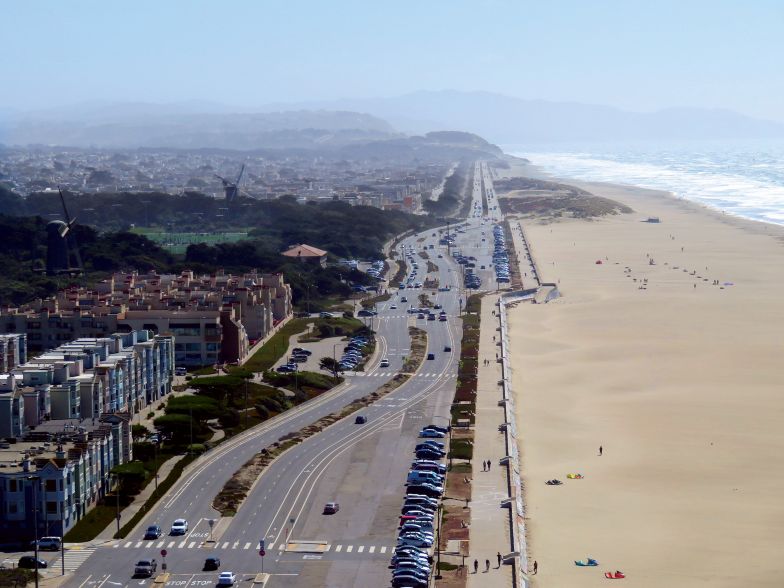 San Francisco’s Great Highway at Ocean Beach. Photo: Pi.1415926535, courtesy of Wikimedia Commons.
The “great” misnomer: It wasn’t built for your commute
The name “Great Highway” conjures images of asphalt and cloverleaf on-ramps. But when the road was first conceived in the late 1860s, the word “highway” meant something very different.
In the Victorian era, a “highway” was simply a public thoroughfare. When the San Francisco Board of Supervisors and the Park Commission began planning the road in 1868, they weren’t thinking about traffic flow or “level of service.” They were thinking about leisure.
The Victorian Promenade (1870s–1890s)
In the late 1800s, this stretch of coastline was a rugged, wild boundary where the city simply ended. When the Board of Supervisors established the “Great Highway” in 1868, they didn’t have pavement in mind; they were creating a 180-foot-wide scenic corridor for horses, carriages, and the brand-new “safety bicycle.”
Sights to see included the Cycler’s Rest (a clubhouse for cycling enthusiasts) and Carville-by-the-Sea (a village of abandoned horsecars and cable cars). You might go beach combing at the “House of Mystery” or race your buggy or bicycle along the sandswept road.
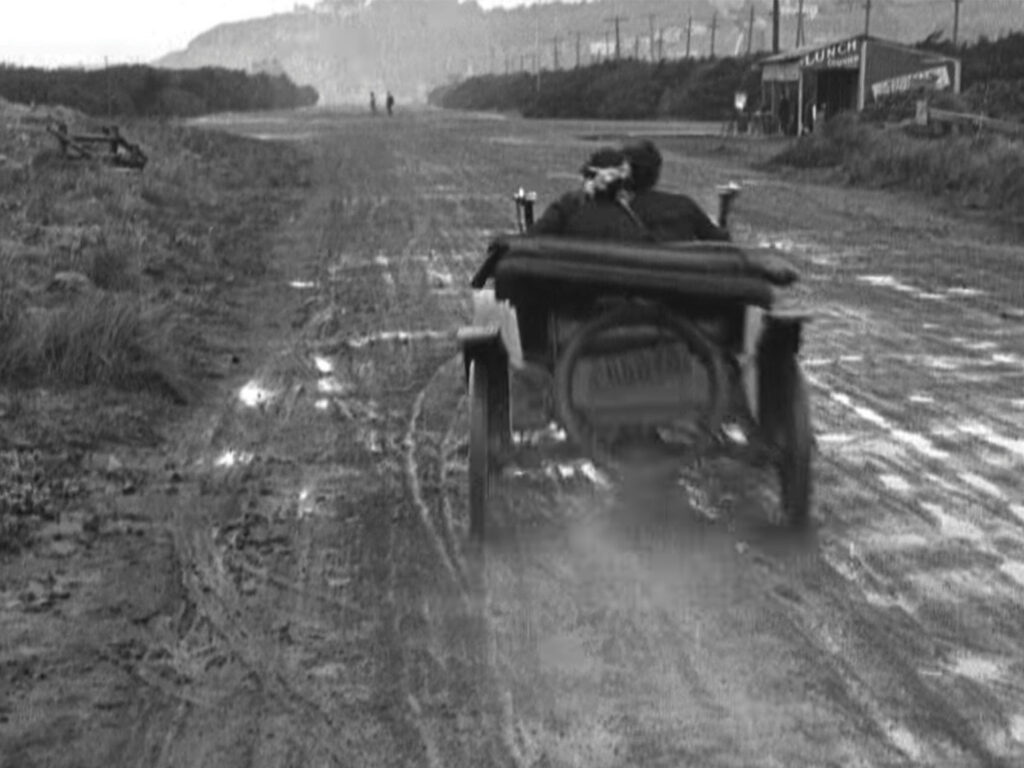 Charlie Chaplin and Edna Purviance drive on the Great Highway in the 1915 film A Jitney Elopement. Photo: Scenography, courtesy of Wikimedia Commons.
The era of the “Scenic Drive” (1920s)
As the automobile took over, the road was paved and widened in the 1920s. Even then, city planners like M.M. O’Shaughnessy (of Hetch Hetchy and Muni tunnel fame) designed it as a “scenic boulevard.” It featured grand pedestrian underpasses, sprawling beach access, and a design that prioritized the view of the Pacific. It was never intended to be a shortcut; it was a destination.
This was also the era of Playland-at-the-Beach, a legendary 10-acre amusement park along the coastline, home of the Big Dipper wooden roller coaster. The Esplanade was dedicated in 1929: a massive concrete seawall and tiered walkway built to hold back the Pacific while giving pedestrians a “front-row seat” to the ocean.
 The Big Dipper roller coaster at Playland-at-the-Beach. Photo: James R., courtesy of Wikimedia Commons.
When the road became a roof (1980s)
The modern, high-speed feel of the Great Highway is actually a relatively recent invention. In the late 1980s, the road underwent a massive reconstruction. But the primary goal wasn’t transportation — it was environmental protection.
The city needed to build the Westside Transport Box, a massive underground sewer system designed to keep San Francisco’s wastewater from overflowing into the ocean during storms (a requirement of the Clean Water Act). The “Highway” we know today is essentially the roof of a giant sewage treatment project. It was during this era that the road was straightened and optimized for cars, stripping away much of its original “park-like” character.
Returning to the roots: The park is the point
For decades, the Great Highway was stuck in an identity crisis. It was a scenic parkway that we treated like a freeway. This created a dangerous environment for cyclists and pedestrians and cut off the Sunset neighborhood from its arguably greatest natural asset: the beach.
When the pandemic hit in 2020 and the road was closed to cars, San Franciscans didn’t discover a new use for the space — they rediscovered its original use. The “Great Highway Park” is essentially a 21st-century version of the 1870s carriage drive.
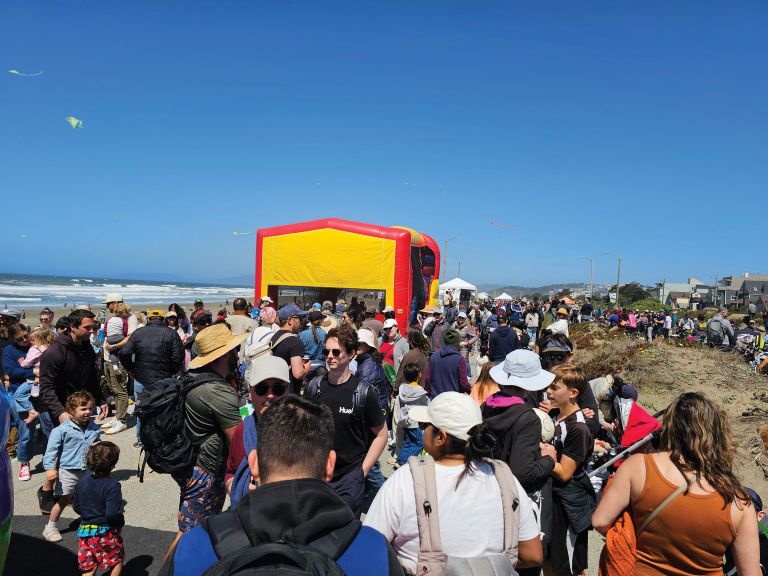 Opening day of Sunset Dunes Park on April 12, 2025. Photo: Oeoi, courtesy of Wikimedia Commons.
Why the history matters for safety and advocacy
For us, this history provides a powerful counter-argument to the idea that “the Great Highway has always been a highway!”
The Great Highway was legally and historically established as part of the Golden Gate Park system, not the state highway system. In fact, despite its name, it was never a designated State Highway (California Highway 1 runs along 19th Avenue). By removing high-speed vehicle traffic from a coastal erosion zone, the city didn’t just create a park; it eliminated a high-injury corridor. Finally, for the residents of the Sunset, the park represents a shift from “living next to a road” to “living next to an oceanfront promenade.”
The bottom line
The Great Highway was born as a place for people to enjoy the edge of the world. After a 40-year detour as a commuter cut-through, the vote for Sunset Dunes ensures that its future will finally look a lot like its past: a safe, open, and “great” way for everyone — whether they are on two wheels or two feet — to enjoy the Pacific coast.
___________
As we move toward a permanent park, remember that your rights as a cyclist and pedestrian in these “shared spaces” are paramount. The transition of the Great Highway is a victory for public safety and a reminder that our streets can — and should — evolve to meet the needs of people over horsepower.
Have you or someone you know been involved in a bicycle crash? Want to know about your rights? Are you a lawyer handling a bicycle crash who wants the best result for your client? Contact Bicycle Law at (866) 835-6529 or info@bicyclelaw.com.
Bicycle Law’s lawyers practice law through Coopers LLP, which has lawyers licensed in California, Oregon, and Washington state, and can affiliate with local counsel on bicycle cases across the country to make sure cyclists benefit from cycling-focused lawyers.